
Attic ventilation is one of the biggest reasons a shingle roof lasts its full life or wears out early. In Birmingham and New Orleans, asphalt shingle roofs typically last 15 to 20 years, and where a roof lands in that range depends on three things: shingle quality, installation quality and attic ventilation.
This article explains how attic ventilation works, why it makes a roof last longer, the signs that your attic is not breathing well, and why intake and exhaust vents need to be in balance.
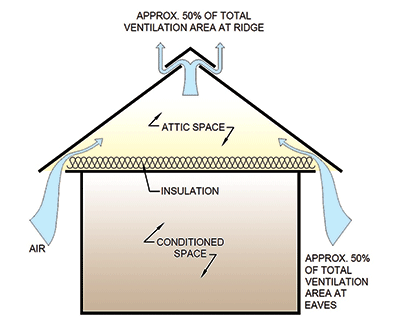
Understanding Attic Ventilation
Attic ventilation is the steady flow of outside air through your attic. It uses two kinds of vents that work as a team:
- Intake vents sit low on the roof, usually in the soffits. Soffits are the panels under the roof overhang. Cooler outside air comes in here.
- Exhaust vents sit at or near the peak of the roof, such as a ridge vent. Hot, damp air leaves here.
Hot air rises, so as the attic warms up, air flows out the top and pulls fresh air in at the bottom. When this works, your attic stays closer to the outdoor temperature and stays dry. When it does not, heat and moisture get trapped right under your roof.
Why Attic Ventilation Makes Your Roof Last Longer
It Keeps Shingles From Cooking From Below
On a sunny summer day, an attic without good airflow can get much hotter than the air outside. That trapped heat bakes the shingles from underneath as well as from the sun on top. Over time, the shingles dry out, curl, crack and lose granules faster. Granules are the sand-like grains that protect shingles from the sun. Read more about what summer heat does to your roof.
It Prevents Moisture Damage
Everyday living puts a lot of moisture into the air from cooking, showers and laundry. Warm, damp air rises into the attic. If it cannot get out, it condenses on the cool underside of the decking, which is the layer of wood boards the shingles are nailed to. That leads to mold, rot, rusty nails and soft spots in the roof deck. New Orleans humidity makes this a problem for much of the year.
It Protects Your Shingle Warranty
Shingle manufacturers expect proper attic ventilation. If a roof fails early because the attic was not vented correctly, the warranty may not cover it. As a GAF and CertainTeed certified roofer, we check ventilation on every roof we install so the warranty you are paying for is one you can actually use.
It Helps Your HVAC System
A hot attic pushes heat down through the ceiling, so your air conditioner works harder and runs longer. Good ventilation can lower cooling costs and take some strain off your AC. For more on how your roof and attic affect your energy bills, see our roof maintenance checklist and HVAC guide.
Signs of Poor Attic Ventilation
You do not need special tools to spot many ventilation problems. Watch for these signs:
- The attic feels like an oven on a hot afternoon, far hotter than outside
- Upstairs rooms stay hot even with the AC running
- Shingles are curling, blistering or losing granules years before they should
- Rusty nail tips, damp insulation or dark stains on the underside of the decking
- Frost on the decking on cold winter mornings
- A musty smell or mold in the attic
How to Inspect Your Attic Ventilation
- Check vent placement. From outside, look for soffit vents under the overhang and a ridge vent or other exhaust vents near the peak.
- Look for blockages. In the attic, make sure insulation is not stuffed against the soffit vents. Outside, check that soffit vents are not painted over or clogged.
- Feel the temperature. On a hot day, compare the attic to the outdoor air. If it is much hotter, airflow is probably too low.
- Look for moisture. Use a flashlight to check the decking and rafters for stains, mold or rust.
Only go into your attic if it is safe, and stay on the framing. If you are not sure what you are looking at, we can check it for you during a free roof inspection.
Intake vs. Exhaust: Why Balance Matters
A ventilation system only works when air can get in and get out. Most building codes call for about 1 square foot of open vent area for every 150 square feet of attic floor, or 1 for every 300 when the vents are balanced between high and low. Shingle makers generally recommend that intake be at least equal to exhaust.
When the system is out of balance, problems follow:
- Too little intake: Exhaust vents cannot pull in fresh air from the soffits, so they may pull air from the house instead, including cooled air. They can also draw rain in through other roof vents.
- Too little exhaust: Air comes in, but the heat and moisture have nowhere to go.
- Mixed exhaust types: A ridge vent combined with box vents or a power fan on the same roof can short-circuit the airflow. One exhaust vent pulls air in through the other, and parts of the attic get no fresh air at all.
The right mix depends on your roof shape and attic. To compare ridge vents, soffit vents, box vents, turbines, powered fans and gable vents, read our guide to choosing the right roof ventilation system.
Common Attic Ventilation Problems and Solutions
Not Enough Ventilation
Many older homes were built with too few vents. The fix is to add intake, exhaust or both, sized to your attic. This is often done at the same time as a roof replacement.
Blocked Vents
Insulation, paint, debris and bird nests can block vents. Baffles, which are simple channels installed between rafters, keep insulation away from the soffit vents so air can flow.
Poor Vent Placement
Intake vents belong low in the soffits or eaves, and exhaust vents belong near the peak. Vents placed in the wrong spots can leave hot, damp pockets in the attic.
Ventilation vs. No Ventilation: What It Costs You
| Setup | Summer attic | Effect on shingles | Effect on HVAC |
|---|---|---|---|
| No ridge vent and no soffit vents | Very hot and often damp | Bakes from below; wears out early | Heavy heat load; AC runs longer |
| Ridge vent only (no intake) | Still hot | Some help, but not enough | Can pull cooled air out of the house |
| Soffit vents only (no exhaust) | Still hot | Air comes in but cannot leave; little benefit | Little improvement |
| Balanced ridge and soffit system | Closer to outdoor temperature | Normal aging; best chance at full life | Lower heat load; can lower cooling costs |
DIY vs. Professional Attic Ventilation
Clearing a blocked soffit vent or pulling insulation back from the eaves is something many homeowners can do. Cutting a ridge vent, adding soffit vents or sizing a full system is a different job. It means cutting into the roof, working at height and doing the math on vent area. Mistakes can cause leaks or make airflow worse.
A professional can measure your attic, check what you have now and recommend the simplest fix. That might be adding intake, removing a vent that is competing with the ridge vent, or upgrading the whole system during a new roof.
Why Choose Capstone Roofing
We are a family-owned roofer serving Birmingham since 2013, with a local office in Metairie for the New Orleans area. We are licensed and insured, and certified with both GAF and CertainTeed. Every roof we install includes a ventilation check and at least a 5-year workmanship warranty, with 10-year and lifetime options.
Frequently Asked Questions
How do I know if my attic is properly ventilated?
Check the attic on a hot afternoon. If it feels like an oven, airflow is probably too low. From outside, look for open soffit vents under the overhang and a ridge vent or other exhaust at the peak. If either is missing, the system is likely out of balance. A roofer can measure your vent area against what the attic needs.
Can I add ventilation without replacing my roof?
Yes. A ridge vent can be cut into an existing roof, soffit vents can be added to closed soffits, and baffles can clear blocked vents. Still, if your roof is near the end of its life, it often makes sense to fix ventilation as part of the replacement.
Does attic ventilation affect my energy bill?
It can. A well-vented attic sends less heat down into your living space, so your AC does not have to work as hard. Savings vary by home, insulation and AC system, but in a Birmingham or New Orleans summer, a cooler attic helps.
What is the difference between passive and active ventilation?
Passive ventilation, like ridge and soffit vents, uses natural airflow and needs no power. Active ventilation uses an electric or solar fan to push air out. For most homes in our area, a balanced passive system works well with no moving parts. A powered fan can help in some cases, but if there is not enough intake, it may pull cooled air from your house.
Get Your Attic Ventilation Checked
If your attic runs hot, your shingles are aging early or you just want to know where you stand, we can help. Call our Birmingham office at (205) 453-1803 or our New Orleans area office at (504) 302-0204, or request a free inspection online.